Project Background
I was part of a team of five tasked with solving issues related to women’s menstrual periods. We conducted interviews with stakeholders and users, and delivered a solution within three months. We’ve decided to use Design Thinking to get us through the whole process.
Roles & Responsibilities
I took on the role of a UX/UI Designer and Team Lead due to my software engineering skills and my activeness.
01 - Empathize Business and Users
Interview with Stakeholder
Before starting any design work, we needed to interview our business stakeholders or the people funding the project. So, we went straight to ask our stakeholder what she expected to build. Here’s who she is and what she wants.
Name: Pizza
Role: CEO of a sanitary pad company in Thai (Just a role play from Bootcamp)
Business Needs:
- Increase sales in sanitary pad
- Focus on building any solutions that would engage with women
- Build branding for the sanitary pad
Interview with Users
Since her goals were not clear and did not provide a clear direction for building an application, and we were five men who knew nothing about menstrual periods and sanitary pads, we went straight to interview women about menstrual period problems to understand more about these issues. We created our initial research goals and began interviewing users.
Our initial research goals were:
- Current methods and brands of buying sanitary pads
- How to prepare the sanitary pads for before, during, and after periods
- How women count their menstrual periods
- Understanding the symptoms during menstrual periods
Then, each of us when for an interview, asked for more information and discussed what we discovered.
Findings
We found that:
- All the users are using sanitary pads
After this findings, we thought that it was not enough for 5 subjects of interview. So, we crafted new research goals, research questions, and go out for another 10 interviews.
Findings (2)
We found that:
02 - Define the Problem
We use Affinity Mapping to classify the landscape of persona and their voices from data we’ve interviewed. We found interesting personas and anti-persona.
Affinity Mapping
Persona
How Might We (HMW)
Prioritization Matrix
03 - Ideation for Solution
After we defined the problem and personas. Now, it’s time to ideate a solution. From the problem statement, we thought that building an menstrual period tracking app would be one of the solutions. So, we sketch a wireframe on a paper and go out for an interview to validate our solution. Here’s our wireframes.
Wireframes
We then developed them into low-fidelity designs.
Low-fidelity Designs
After finishing the low-fidelity designs, we skipped the mid-fidelity designs due to time constraints. We then created high-fidelity designs.
High-fidelity Designs
04 - Prototyping
This is a very fun and excited part of the project since we have one day to draw a prototype, and go for a usability testing before the final presentation.
Our Solution
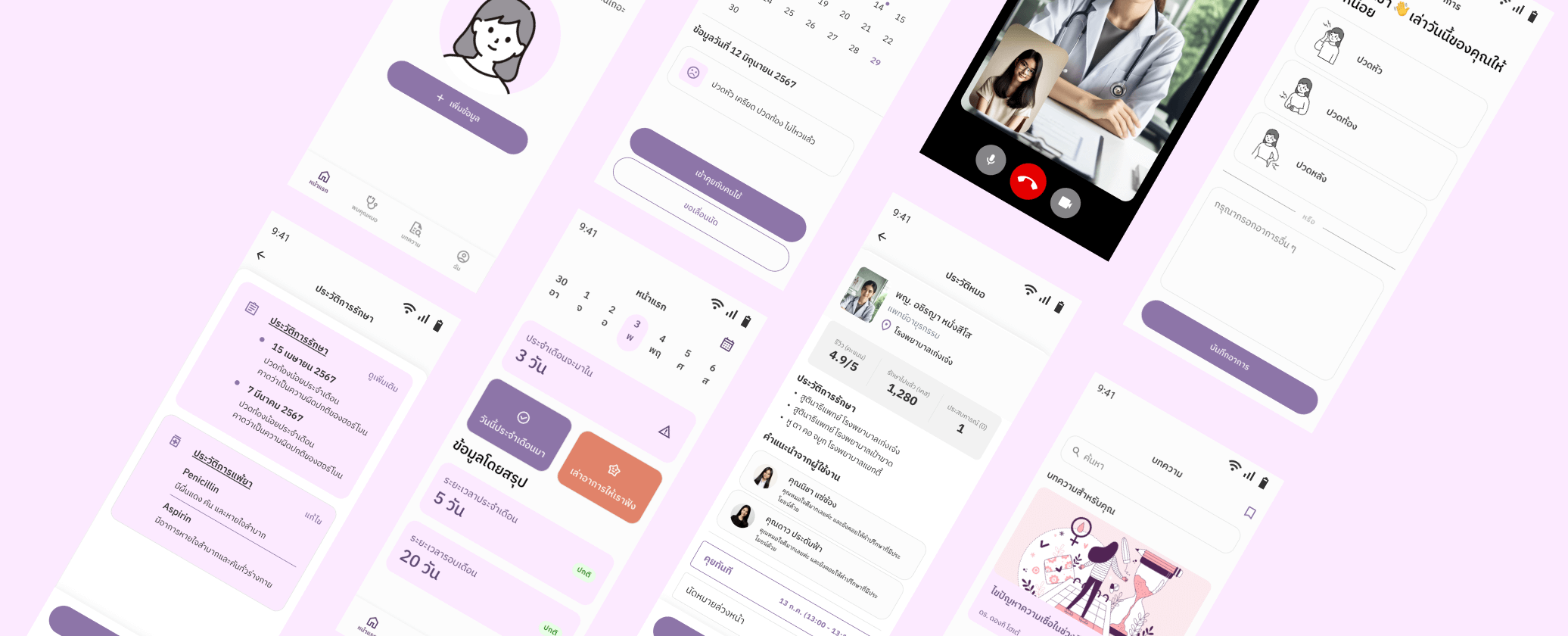
Sukkee: A menstrual period tracking application that would help women to keep track of their periods with ease.